


Internal tank polishing is a critical surface finishing process for stainless steel tanks used in food processing, pharmaceutical production, chemical manufacturing, beverage storage, and other sanitary industries. A properly polished tank interior is not simply about appearance. It can improve cleanability, reduce product contamination risks, and help manufacturers achieve consistent surface quality.
However, polishing the inside of a tank presents unique challenges. Limited working space, curved surfaces, weld seams, and strict surface roughness requirements make manual polishing difficult and time-consuming.
This guide explains the main internal tank polishing methods, the machines used in modern manufacturing, and important safety considerations for achieving an efficient and consistent finish.
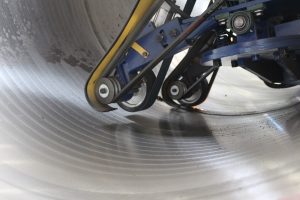
What Is Internal Tank Polishing?
Internal tank polishing is the process of grinding, smoothing, and finishing the inner surface of a metal tank or vessel.
The process is commonly used on stainless steel tanks to remove:
-
Weld marks and weld discoloration
-
Surface scratches
-
Oxide layers
-
Rough metal areas
-
Manufacturing defects
-
Uneven surface textures
Depending on the application, the final surface may range from a standard industrial finish to a fine sanitary or mirror finish.
For example, a chemical storage vessel may require a smooth, corrosion-resistant surface, while a pharmaceutical mixing tank may need much stricter surface roughness control.
The required finish determines the polishing method, abrasive sequence, and type of tankı parlatma makinesi used.
Why Is Internal Tank Polishing Important?
The inside surface of a tank comes into direct contact with stored or processed materials. Poor surface quality can create small grooves, scratches, or irregular areas where product residue can accumulate.
This can cause several problems.
Improved Cleanability
A smoother stainless steel surface is generally easier to clean. Product residue is less likely to remain in deep scratches or rough areas.
This is particularly important for tanks used in food, dairy, beverage, and pharmaceutical production.
Better Surface Consistency
Manual polishing depends heavily on operator skill. Different workers may apply different pressure, polishing angles, or processing times.
Automatic internal tank polishing equipment can provide more consistent grinding pressure and movement.
Reduced Contamination Risks
Surface defects may create areas where unwanted residues can accumulate. Achieving the specified surface finish can support hygienic tank design and cleaning procedures.
Improved Tank Appearance
For high-value stainless steel processing equipment, surface quality is also an important indicator of manufacturing quality.
A uniform polished finish can improve the overall appearance and perceived quality of the finished vessel.
Common Internal Tank Polishing Methods
There is no single polishing process suitable for every tank. Manufacturers should select the method according to tank diameter, length, material, surface condition, and required finish.
1. Manual Internal Tank Polishing
Manual polishing usually involves handheld grinders, polishing wheels, or abrasive tools.
An operator enters or reaches inside the tank and manually processes the surface.
The main advantage is flexibility. Workers can polish irregular areas, weld seams, corners, and local defects.
However, manual polishing has several disadvantages:
-
High labor requirements
-
Inconsistent surface quality
-
Longer processing time
-
Greater dependence on operator experience
-
Increased safety concerns
For large-volume tank production, fully manual polishing may become a production bottleneck.
2. Abrasive Belt Polishing
Abrasive belt polishing is widely used for stainless steel tank surface finishing.
The abrasive belt removes surface defects through controlled contact with the tank wall. Different abrasive grits can be used during multiple polishing stages.
A typical process may begin with a coarse abrasive for grinding and gradually move to finer abrasives for surface finishing.
The exact grit sequence depends on the original surface condition and final finish requirements.
An automatic internal tank polishing machine can control belt movement, contact pressure, and polishing travel more consistently than manual operation.
3. Polishing Wheel and Buffing
Polishing wheels or buffing wheels are often used during finer finishing stages.
After grinding marks have been reduced, a polishing wheel can help improve surface brightness and uniformity.
For mirror polishing applications, manufacturers may use multiple finishing steps and suitable polishing compounds.
It is important to remember that mirror polishing normally requires proper surface preparation. A polishing wheel cannot efficiently hide deep scratches or major weld defects.
The surface should be progressively refined before the final buffing stage.
4. Automatic Internal Tank Polishing
Automatic polishing systems are increasingly used by tank and pressure vessel manufacturers.
These machines use controlled mechanical movement to polish the tank interior. Depending on the machine design, the polishing head may move along the tank length while the tank rotates.
Some systems use programmable or CNC-controlled movements.
The key advantages include:
-
Daha yüksek üretim verimliliği
-
More consistent surface quality
-
Reduced manual labor
-
Better process repeatability
-
Easier abrasive process control
For manufacturers producing stainless steel tanks in batches, automation can significantly improve polishing productivity.
How Does an Internal Tank Polishing Machine Work?
The working principle varies depending on machine configuration.
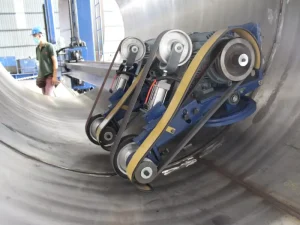
In a typical automatic tank polishing system, the stainless steel tank is positioned on rotating rollers. The tank rotates at a controlled speed while the polishing head enters the vessel.
The polishing unit moves along the internal surface.
The machine may use an abrasive belt, grinding wheel, or polishing wheel to process the metal surface.
Operators can adjust parameters such as:
-
Tank rotation speed
-
Polishing head travel speed
-
Grinding pressure
-
Abrasive belt grit
-
Number of polishing passes
By combining tank rotation with controlled polishing head movement, the machine can cover a large internal surface more evenly.
For long tanks, automatic travel systems are particularly useful because manual polishing over several meters can be physically demanding and difficult to control.
Understanding Surface Roughness in Tank Polishing
Surface roughness is an important consideration when polishing stainless steel tanks.
Ra, or average surface roughness, is commonly used to describe surface finish quality.
A lower Ra value generally indicates a smoother surface.
However, the correct surface roughness requirement depends on the tank application and customer specification.
Manufacturers should avoid assuming that every tank needs a mirror finish. Over-polishing can increase production time and abrasive consumption without providing additional value for the final application.
Before selecting a polishing process, confirm:
-
Required Ra value
-
Industry application
-
Customer surface specification
-
Tank material
-
Original surface condition
The polishing process should then be designed around the required result.
Internal Tank Polishing for Different Industries
Different industries have different surface finishing requirements.
Food and Beverage Tanks
Food-grade stainless steel tanks require smooth, cleanable surfaces.
Internal polishing is commonly used for mixing tanks, dairy tanks, brewing vessels, and beverage storage equipment.
Special attention should be given to weld areas and surface defects.
Pharmaceutical Tanks
Pharmaceutical vessel manufacturing often requires strict surface quality control.
Consistent internal finishing and documented surface specifications may be important parts of the production process.
Automatic polishing can help improve repeatability between different vessels.
Chemical Storage Tanks
Chemical tanks may require surface finishing to improve corrosion performance and remove manufacturing defects.
The polishing process should be selected according to the stainless steel grade and the chemical application.
Basınçlı Kaplar
Pressure vessel manufacturers often need to polish cylindrical tank shells and dish heads.
Because dish heads have curved geometries, manufacturers may use dedicated bulaşık başlığı parlatma makineleri alongside tank shell polishing equipment.
Safety Considerations for Internal Tank Polishing
Safety is one of the most important aspects of internal tank polishing.
Manual work inside a tank may involve confined-space hazards. Manufacturers should establish appropriate workplace procedures in accordance with local regulations and the specific production environment.
Important considerations include ventilation, dust extraction, equipment isolation, and worker protection.
Control Grinding Dust
Grinding and polishing can generate metal and abrasive dust.
An appropriate dust collection or extraction system should be considered to maintain a cleaner working environment.
Use Proper Personal Protective Equipment
Depending on the process, operators may require eye protection, hearing protection, gloves, and suitable respiratory protection.
PPE selection should be based on a workplace risk assessment.
Inspect Abrasive Tools
Abrasive belts, grinding wheels, and polishing tools should be inspected regularly.
Damaged or incorrectly installed abrasives may create safety risks and reduce polishing quality.
Reduce Manual Confined-Space Work
Where practical, automatic internal tank-polishing equipment can reduce the time operators spend manually working inside large vessels.
Automation does not eliminate all risks, but it can change the nature and extent of worker exposure.
How to Choose an Internal Tank Polishing Machine
Before purchasing a tank polishing machine, manufacturers should clearly define their production requirements.
Consider the following factors:
-
Minimum and maximum tank diameter
-
Maximum tank length
-
Stainless steel material grade
-
Internal or external polishing requirements
-
Required surface roughness
-
Mirror finish requirements
-
Daily production capacity
-
Level of automation
You should also evaluate the machine manufacturer’s ability to customize the equipment.
Tank dimensions vary significantly between industries. A standard machine may not be suitable for every pressure vessel or storage tank production line.
Providing tank drawings, dimensions, material information, and target surface finish can help the equipment supplier recommend a more suitable polishing solution.
Son Düşünceler
Internal tank polishing plays an important role in stainless steel tank and pressure vessel manufacturing. The correct polishing process can improve surface consistency, cleanability, production efficiency, and overall vessel quality.
Manual polishing remains useful for local repairs and complex areas. However, automatic internal tank polishing machines offer significant advantages for manufacturers that require repeatable surface quality and higher production capacity.
The best polishing solution depends on tank size, material, original surface condition, and required Ra value.
If you are planning to upgrade your stainless steel tank polishing process, evaluate your current production challenges and surface finish requirements before selecting equipment.
Looking for an internal tank polishing machine for your production line? Contact our team with your tank diameter, length, material, and required surface finish. We can help you evaluate a suitable automatic polishing solution for your application.
SSS
What is internal tank polishing?
Internal tank polishing is the process of grinding, smoothing, and finishing the inner surface of a stainless steel tank or vessel. It removes weld marks, scratches, oxidation, and surface defects to achieve a smoother and more consistent finish.
What machine is used to polish inside stainless steel tanks?
An internal tank polishing machine is commonly used to grind and polish the inner surface of cylindrical stainless steel tanks. The machine may use abrasive belts, grinding wheels, or polishing wheels with controlled tank rotation and polishing head movement.
How do you achieve a mirror finish inside a stainless steel tank?
A mirror finish is typically achieved through multiple grinding and polishing stages. Manufacturers gradually use finer abrasive grits before applying polishing wheels or buffing compounds for the final surface finishing process.
What Ra value is required for stainless steel tanks?
The required Ra surface roughness depends on the tank application and customer specifications. Food, beverage, and pharmaceutical tanks may require smoother internal surfaces than general industrial storage tanks.
Is automatic tank polishing better than manual polishing?
Automatic tank polishing provides better process consistency, higher production efficiency, and reduced dependence on operator skill. Manual polishing remains useful for weld areas, local defects, and complex tank geometries.
Can a tank polishing machine polish both internal and external surfaces?
Some tank polishing machines can be designed for both internal and external polishing. Machine configuration depends on the tank diameter, length, surface finish requirements, and production process.