


Investing in a dish head polishing machine is a major decision for pressure vessel manufacturers, tank fabricators, and metal forming companies. Whether you specialize in stainless steel storage tanks, pharmaceutical reactors, or food-grade pressure vessels, the quality of your dish head finishing process directly affects product performance, compliance, and customer satisfaction.
However, not all polishing machines are created equal. Choosing the wrong equipment can lead to surface defects, high operating costs, inefficiency, and limited scalability.
In this guide, we’ll break down the top 5 critical factors you must evaluate before purchasing a dish head polishing machine—so you can make a smart, ROI-driven decision.
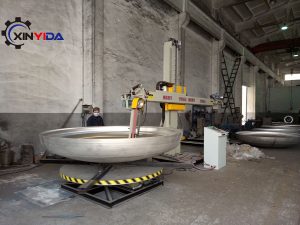
1. Compatibility with Dish Head Types and Sizes
The first and most important factor is machine compatibility.
Dish heads come in various shapes and standards, including:
-
Torispherical heads
-
Ellipsoidal heads
-
Hemispherical heads
-
ASME flanged and dished heads
If your production involves compliance with standards such as those defined by the American Society of Mechanical Engineers (ASME), your polishing system must handle precise geometries without compromising structural integrity.
Key Questions to Ask:
-
What is the maximum and minimum diameter capacity?
-
Can it process varying curvature profiles?
-
Does it support different material thicknesses?
-
Is it adjustable for future product expansion?
Choosing a machine with limited size flexibility may reduce upfront cost—but it can severely restrict future business growth.
Pro Tip: Always choose a system slightly above your current production capacity to accommodate future orders.
2. Surface Finish Requirements (Ra Value)
Different industries demand different surface roughness levels.
For example:
-
Food & beverage industry: Typically requires Ra ≤ 0.8 μm
-
Pharmaceutical industry: May require Ra ≤ 0.4 μm or mirror finish
-
Chemical storage tanks: May allow slightly higher roughness
If your customers operate under standards like the U.S. Food and Drug Administration (FDA), surface finish quality is not optional—it’s mandatory.
Consider These Factors:
-
Can the machine achieve mirror polishing?
-
Does it support multi-stage polishing (coarse → fine → buffing)?
-
Is it capable of internal and external polishing?
-
Does it ensure uniform finish across curved surfaces?
Advanced CNC-controlled polishing systems ensure consistent Ra values and reduce operator dependency.
Remember: Surface finish quality directly impacts corrosion resistance, cleanability, and product lifespan.
3. Automation Level and Production Efficiency
Automation is transforming the metal finishing industry.
Modern dish head polishing machines can be:
-
Manual
-
Semi-automatic
-
Fully automatic (CNC controlled)
With labor costs rising globally, automation improves consistency, reduces human error, and increases throughput.
Compare These Aspects:
| Feature | Manual | Semi-Auto | Full CNC |
|---|---|---|---|
| Labor Cost | High | Medium | Low |
| Consistency | Operator-dependent | Improved | Excellent |
| Output Volume | Low | Medium | High |
| ROI Timeline | Slow | Moderate | Fast |
Fully automated systems often include:
-
PLC control systems
-
Servo motor positioning
-
Automatic pressure adjustment
-
Programmable polishing paths
If your business plans to scale production or export internationally, automation should be a priority—not an afterthought.
4. Material Compatibility and Abrasive System
Dish heads are typically manufactured from:
-
Stainless steel (304/316L)
-
Carbon steel
-
Duplex stainless steel
-
Nickel alloys
Each material requires different polishing pressure, abrasive types, and speed settings.
Before buying, verify:
-
Does the machine support variable speed control?
-
Can it handle heavy-duty grinding for carbon steel?
-
Is the abrasive system easy to change?
-
Does it support belt polishing, flap wheels, or buffing discs?
High-quality dish head polishing machines allow quick abrasive replacement, reducing downtime and improving productivity.
Additionally, consider whether the machine includes dust collection systems. Polishing stainless steel generates fine particles that must be properly managed for worker safety and environmental compliance.
5. Total Cost of Ownership (TCO)
Many buyers focus only on initial purchase price. That’s a mistake.
Instead, evaluate Total Cost of Ownership, including:
-
Installation cost
-
Operator training
-
Maintenance expenses
-
Spare parts availability
-
Energy consumption
-
Downtime risks
A cheaper machine may require frequent maintenance, increasing long-term costs.
Ask the Supplier:
-
What is the warranty period?
-
Are spare parts locally available?
-
Is remote technical support provided?
-
What is the estimated maintenance schedule?
A reliable supplier should provide:
-
Clear maintenance documentation
-
Technical training support
-
After-sales service commitment
Remember: A dish head polishing machine is a long-term industrial asset—often used for 10–15 years.
Bonus Consideration: Supplier Expertise and Industry Experience
Beyond the machine itself, the manufacturer’s expertise matters.
Look for suppliers who:
-
Specialize in tank and pressure vessel finishing equipment
-
Have export experience
-
Provide customization options
-
Offer factory testing before shipment
Request videos of actual machine operation, case studies, and client references before making a decision.
Final Thoughts
Buying a dish head polishing machine is not just an equipment purchase—it’s a strategic investment in production quality, efficiency, and brand reputation.
To recap, always evaluate:
-
Size and geometry compatibility
-
Surface finish capability
-
Automation level
-
Material adaptability
-
Total cost of ownership
Making the right choice will help you:
-
Improve polishing consistency
-
Reduce labor costs
-
Meet international standards
-
Increase production efficiency
-
Strengthen customer trust
If you’re planning to upgrade your tank fabrication line, now is the time to assess your polishing process carefully.
FAQ
-
What size dish head can a polishing machine handle?
Dish head polishing machines are available in various capacities, typically ranging from 500mm to over 5000mm in diameter. Before purchasing, confirm the maximum and minimum diameter, thickness range, and compatibility with torispherical, ellipsoidal, or hemispherical heads to ensure it matches your production needs.
-
Can a dish head polishing machine achieve a mirror finish?
Yes. High-quality dish head polishing machines can achieve mirror finishes with Ra values as low as 0.4 μm or better. Multi-stage polishing systems using grinding, fine polishing, and buffing processes are typically required to meet pharmaceutical or food-grade surface standards.
-
Is automatic polishing better than manual polishing?
Automatic or CNC-controlled polishing systems offer higher consistency, reduced labor costs, and improved production efficiency compared to manual polishing. They are ideal for manufacturers aiming for large-scale production and consistent surface finish quality.
-
What materials can a dish head polishing machine process?
Most industrial dish head polishing machines can process stainless steel (304/316L), carbon steel, duplex stainless steel, and nickel alloys. It is important to confirm adjustable speed control and abrasive compatibility for different material hardness levels.
-
How much does a dish head polishing machine cost?
The price of a dish head polishing machine depends on size, capacity, automation level, and customization requirements. Manual systems are typically more affordable, while fully automated CNC machines require higher investment but deliver better long-term ROI through efficiency and labor savings.
-
What should I check before choosing a supplier?
Before choosing a supplier, verify industry experience, customization capabilities, after-sales service, spare parts availability, and technical support. Request operation videos, case studies, and factory testing reports to ensure reliability and performance.